

Structural Assessments
Defect assessments that get to the root cause, not just the symptom
Structural defects are rarely what they appear on the surface. A crack in a wall may look like a plaster problem — but it can be telling you about differential foundation settlement, a missing tie rod, a corroded steel lintel, or seasonal movement in reactive clay subsoil. A deflecting floor may feel like a comfort issue — but it can indicate overloaded joists, missing blocking, or a principal beam that is under-designed for the spans it is carrying. Understanding the difference — and diagnosing the true cause — requires a structural engineer, not a builder or a building inspector.
IA Engineering's defect assessments are systematic, engineering-led investigations into structural defects of all types. We inspect the defect, investigate its likely cause, assess its structural significance, determine whether it is active or historical, and produce a written report that gives you the information you need to make decisions — and a specification your builder can act from directly.
Our defect assessment reports are used by homeowners, strata managers, property owners, builders, insurers, and solicitors across NSW. They are prepared by registered professional engineers and written to the standard required for insurance claims, NCAT proceedings, and building dispute resolution.

Defect assessments that get to the root cause, not just the symptom
- Wall cracking & foundation settlement
- Structural deflection & movement
- Corrosion & material deterioration
- Repair specifications & remediation design
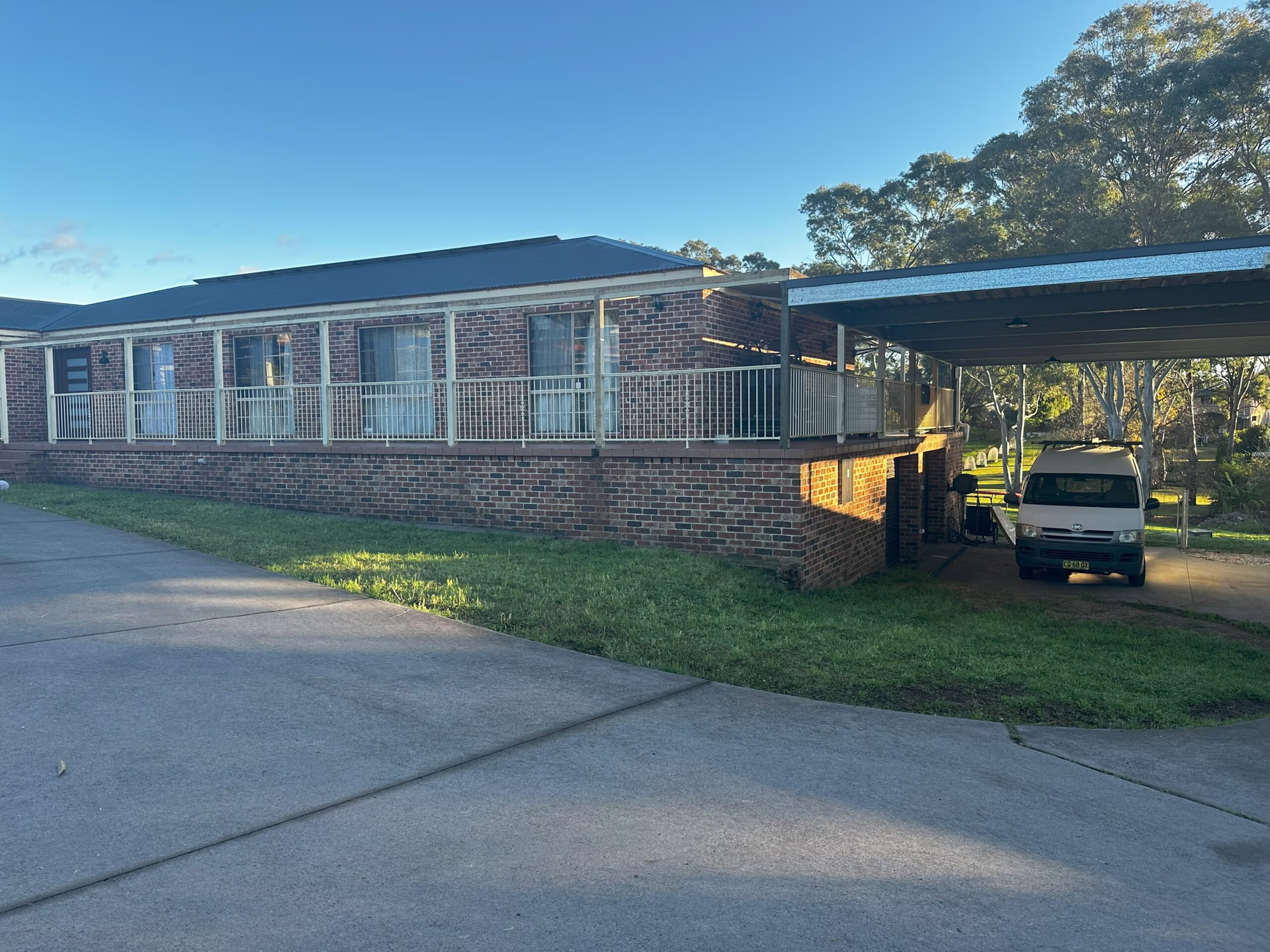
Defect assessment of a residential building showing diagonal cracking in masonry — caused by differential settlement in the reactive clay subsoil.
Types of structural defects we assess
Structural defects manifest in many forms — from the dramatic to the subtle. What they share is that their significance cannot be determined without engineering analysis. A hairline crack in a slab and a step crack through a masonry wall may both look minor, but they can have very different implications depending on their location, pattern, and the structural context in which they appear.
Foundation Settlement & Cracking
Foundation movement is one of the most common sources of structural distress in Australian homes, particularly in Sydney and Western Sydney where reactive clay soils are prevalent. Settlement can be uniform — where the whole building moves together without distortion — or differential, where different parts of the foundation settle by different amounts, causing the building above to rack, crack, and distort. Differential settlement is the more damaging form and produces the characteristic step cracking and door frame distortion that homeowners recognise as “sinking”. Our foundation defect assessments identify the crack pattern, determine whether it is consistent with settlement, analyse the likely mechanism, and assess whether the movement is ongoing or historical. Where ongoing movement is suspected, we can recommend geotechnical investigation to establish the cause and design appropriate remediation.
Structural Deflection & Movement
Excessive deflection in floors, beams, or roofs is a structural serviceability defect that can affect both the function and the safety of a building. Deflecting floors can crack tile finishes, jam doors, and cause distress in non-structural partitions. More seriously, excessive deflection can indicate overloading, member damage, or a design that was inadequate from the outset. Our deflection assessments measure the actual deflection, compare it to the limits prescribed by the applicable Australian Standards, assess the cause, and determine whether the deflection is within acceptable bounds or requires remediation. Where remediation is required, we design the strengthening or replacement solution and provide construction drawings for your builder.
Material Deterioration & Corrosion
Steel and reinforced concrete are both susceptible to corrosion — and in Sydney's coastal and humid conditions, this deterioration can be significant. Corroding steel loses cross-section, reducing strength. Corroding reinforcement in concrete expands, causing the concrete to spall — producing the characteristic rust staining and concrete delamination that indicates structural deterioration. Timber structural members can deteriorate through rot, termite attack, or moisture-related decay. Our material deterioration assessments identify the extent of deterioration, assess the remaining structural capacity of the affected members, and determine whether the structure is currently safe to occupy and use. We provide repair specifications that address both the symptoms and the underlying cause.
Water Infiltration & Structural Damage
Water infiltration is frequently a structural problem, not just a waterproofing problem. Water entering through roof penetrations, failing flashings, or compromised building envelope elements can saturate timber framing, corrode steel connections, degrade concrete, and promote biological growth that accelerates structural deterioration. In post-tensioned concrete slab buildings, water infiltration can also attack tendons, causing catastrophic failure modes that are difficult to detect until significant damage has occurred. Our water infiltration and structural damage assessments distinguish between the waterproofing failure — which is often the contractor's issue — and the structural damage that has resulted, providing clear documentation suitable for insurance claims and builder liability proceedings.
“A crack in a wall tells you something is happening. Understanding why it’s happening — and whether it matters — requires an engineer who has seen what that crack leads to.”
IA Engineering Design Team
Our defect assessment process
A defect assessment is not a visual inspection — it is an engineering investigation. We begin by understanding the defect in its context: when it appeared, how it has changed, what has happened to the building around it, and what the building's history is. We then inspect systematically, working from the defect outward to understand the structural context in which it is occurring.
Where the cause is not evident from inspection alone, we recommend targeted investigation — crack monitoring, concrete testing, geotechnical investigation — to establish the mechanism. Our reports always distinguish between what we observed, what we inferred, and what we recommend investigating further — giving you a clear understanding of the certainty behind each finding.
Defect investigation & mapping
Systematic inspection and mapping of all identified defects, with photographic documentation, crack width measurements, and pattern analysis.
Root cause determination
Engineering analysis of the likely cause or causes of each defect, distinguishing between structural mechanisms and non-structural contributing factors.
Significance assessment
Professional engineering opinion on the structural significance of each defect — whether it represents a safety concern, serviceability issue, or cosmetic matter.
Remediation specification
Where remediation is required, we provide repair specifications in sufficient detail for a builder to scope and price the work — and for the council or certifier to assess.
Applicable Standards
Our defect assessments reference the relevant Australian Standards for each building type and material
How we work with you
Defect assessments are often initiated in the context of an existing dispute — between a homeowner and their builder, between a strata corporation and the original developer, or between a landlord and a tenant. We understand that our report may ultimately be used in legal or tribunal proceedings, and we write and conduct our assessments accordingly: rigorously, transparently, and without bias toward any party.
Where our assessment identifies the need for remedial design — beam replacement, footing underpinning, structural reinforcement — we can carry that work through from investigation to construction certification, providing a single point of professional responsibility. This reduces the risk of scope gaps between the assessment and the remediation and ensures that the engineer who diagnosed the problem is also the engineer who designed the fix.
We are also available to provide expert witness services in NCAT proceedings and District Court building disputes, drawing on our defect assessment reports and the engineering analysis that underlies them. Our expert witness reports follow the applicable court guidelines and are presented to withstand cross-examination.